What Is Cuneiform?
Before we can examine the King List, we need to understand the medium it was written in — because the medium is part of the argument.
Cuneiform is the oldest known writing system in the world. It emerged in southern Mesopotamia — modern-day Iraq — sometime around 3400 to 3100 BC, in the cities of Uruk and other early Sumerian settlements along the Tigris and Euphrates rivers. The word "cuneiform" comes from the Latin cuneus, meaning "wedge," because the writing consists of wedge-shaped impressions pressed into soft clay.
The tool was a reed stylus — a length of marsh reed, cut at an angle to produce a triangular tip. The writing surface was a tablet of wet clay, usually small enough to hold in one hand, shaped by the scribe before writing and left to dry or deliberately fired in a kiln afterward. The scribe pressed the stylus into the wet clay at various angles and depths, producing combinations of wedge-shaped marks that represented syllables, words, numbers, and concepts.
Cuneiform was not an alphabet. It was a mixed system — part logographic (one sign equals one word or concept), part syllabic (one sign equals one sound), and part determinative (a sign that signals the category of the word that follows, such as "this next word is a city name" or "this next word is a deity"). The system contained hundreds of signs, and learning to read and write cuneiform required years of training in a formal school, known in Sumerian as an edubba — literally, "tablet house."
This matters for the King List because it means the document was not produced by casual record-keepers. Cuneiform literacy was a professional skill, confined to a trained class of scribes who spent years learning the system. The people who wrote and copied the King List were specialists — the administrative professionals of their civilization. They produced institutional records as part of their daily work, and the King List was part of that professional output.
The Clay Tablet as a Medium
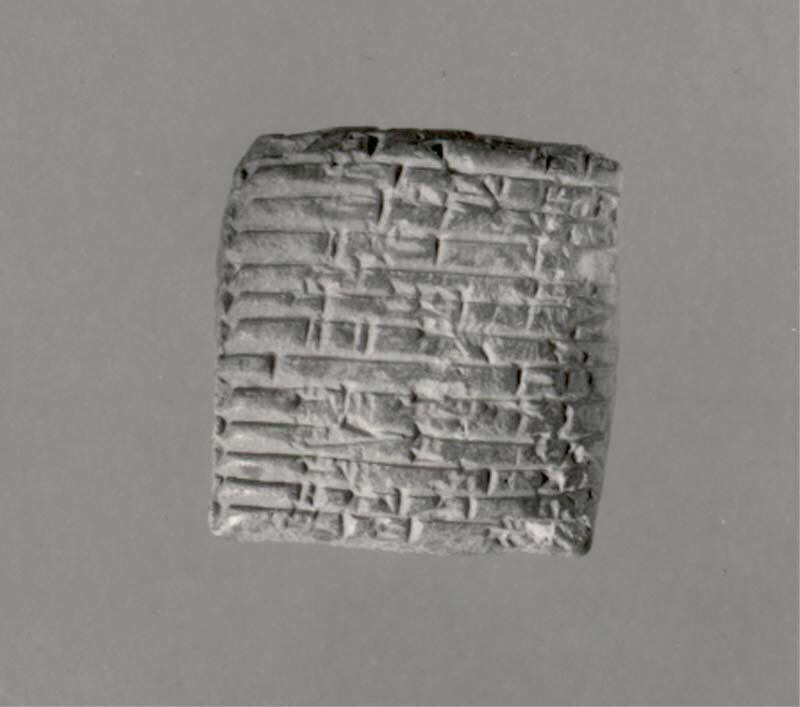
The choice of medium — clay — has consequences that no other ancient writing material can match.
Papyrus, the writing surface of Egypt, is organic. It decays. The vast majority of Egyptian papyrus documents have been lost to time, moisture, insects, and fire. What survives is a fraction of what was written, preserved only in the driest conditions — sealed tombs, desert caves, the rare accident of favorable climate.
Parchment and vellum, used in later periods, are animal skins. They too are organic, and they too decay, though more slowly than papyrus. The medieval manuscripts that survive do so because they were stored in monasteries and libraries with some degree of climate control and institutional continuity.
Clay is inorganic. A clay tablet, once dried, is durable. Once fired — whether intentionally in a kiln or accidentally in the destruction of a building — it becomes nearly indestructible. It does not rot. It does not burn. It does not attract insects. It can sit in the ground for four thousand years and emerge in readable condition.
This is not a minor point. The Sumerian King List survives not because it was treated as sacred or stored in a vault. It survives because the Sumerians wrote on clay, and clay does not care about the passage of time. The same property that made clay tablets heavy and cumbersome in daily use made them immortal in the archaeological record.
When archaeologists excavate a Sumerian site, they frequently find thousands of tablets — administrative records, legal contracts, school exercises, literary compositions, inventories, correspondence. The volume of surviving material is enormous compared to what survives from other ancient civilizations. We have more readable text from third-millennium Mesopotamia than from any other civilization of comparable age, and we have it because the medium was clay.
The King List tablets are part of this larger archive — though their precise classification is more interesting than simply calling them administrative documents. The scholar Gianni Marchesi has described the Sumerian King List as "half-way between a literary text and a list proper" — a document that shares features with both the administrative record-keeping tradition and the literary composition tradition without fitting neatly into either category. It was not a grain invoice. It was not an epic poem. It occupied a space between the two, which may tell us something about the kind of information it was designed to preserve.
How the Copies Were Made
A cuneiform scribe making a copy of an existing tablet worked in a straightforward physical process. The source tablet — the document being copied — sat in front of the scribe, propped up or held in one hand. A fresh lump of wet clay was prepared and shaped into a tablet with the other hand, or prepared in advance by an assistant. The scribe then read the source tablet sign by sign and reproduced each sign on the new wet clay.
This was not oral composition or recitation from memory. It was primarily visual copying — a scribe looking at marks on one surface and reproducing those marks on another. But the process was not purely mechanical. Scribal transmission involved variants, adaptations, and editorial decisions. Scribes sometimes corrected what they believed to be errors in the source, adjusted spellings to match local conventions, or made deliberate editorial choices about what to include or exclude. The surviving King List itself demonstrates this — different versions reflect different scribal decisions about which dynasties to include and how to organize them.
The distinction from oral tradition remains important, however. Oral transmission introduces narrative drift — each teller embellishes, adjusts, forgets, invents. Physical copying, even with editorial intervention, keeps the scribe tethered to the source document in front of him. The variations in cuneiform copies are bounded by what the source says. The variations in oral tradition are bounded only by the teller's imagination.
The scribes understood this distinction, and many of them documented their work explicitly. A significant number of cuneiform tablets end with a colophon — a note added by the scribe after the main text, recording information about the copying process. Colophons might include:
- The scribe's name
- The name of the scribe's teacher or school
- The source of the copy — "copied from an old tablet from [city name]"
- The condition of the source — "the original was damaged" or "the original was old and difficult to read"
- The date of the copy
- The purpose of the copy — sometimes a notation that the tablet was a school exercise
These colophons are the ancient equivalent of version control. They tell us not just what was written, but who wrote it, when, from what source, and under what conditions. Few ancient writing traditions provide this level of documentation about their own transmission process.
The Scribal Schools
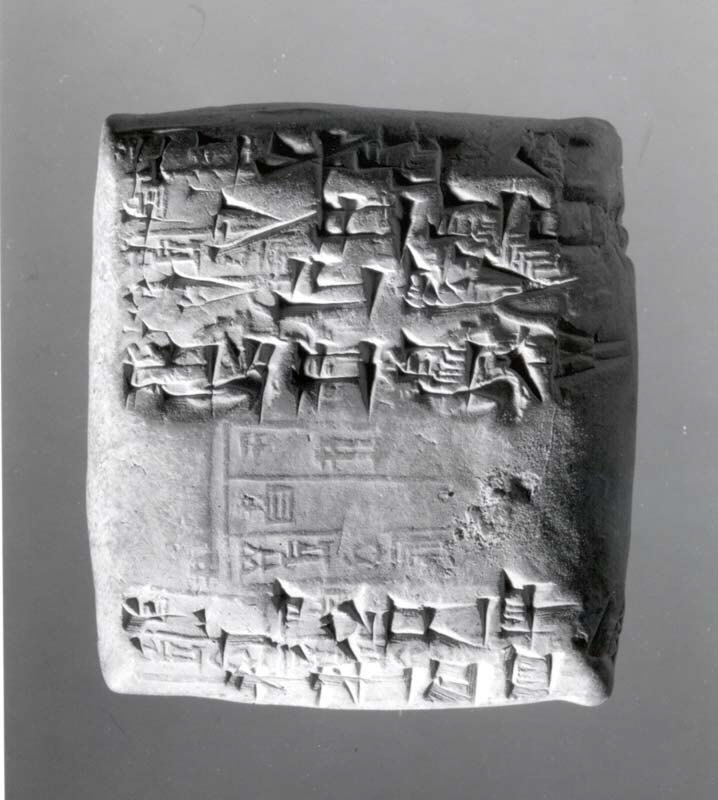
Cuneiform literacy was not widespread. It was a professional skill, acquired through years of formal education at an institution the Sumerians called the edubba — the "tablet house." These schools have been excavated at multiple cities, most extensively at Nippur, where the scribal quarter has yielded thousands of tablets that paint a remarkably detailed picture of how scribes were trained, what they learned, and what kind of people they were.
The edubba was not a temple. It was not a palace. It was a school — and it functioned like one in ways that a modern student would recognize immediately. There was a headmaster, called the ummia — the "expert" or "professor." There were assistant teachers. There were monitors — senior students who supervised younger ones. There were specific roles for maintaining discipline, including a figure known as the "man of the whip," whose job title is self-explanatory.
Students were overwhelmingly male, drawn from families with the means to spare a son from labor for several years. The profession of scribe was respectable and lucrative — scribes served in temples, palaces, and private businesses, handling the administrative work that kept the economy running. A family that invested in a son's scribal education was investing in a career, not a spiritual calling.
The curriculum was extensive and followed a structured progression that scholars have partially reconstructed from the practice tablets left behind.
The earliest stage was sign lists — hundreds of cuneiform signs, learned by repetitive copying. A student would write rows of the same sign, over and over, until the hand knew the motion without thinking. These practice tablets survive in enormous quantities. They are the ancient equivalent of a child's penmanship exercises, and they look exactly like what they are: tedious, repetitive, necessary drills.
Next came lexical lists — vocabulary organized by category. Lists of professions. Lists of animals. Lists of cities. Lists of wooden objects, stone objects, metal objects. Lists of body parts. Lists of foods. These were not creative exercises. They were data. A trained scribe needed to be able to write the correct sign for any object, any profession, any commodity that might appear in an administrative document. The lexical lists were the reference library, memorized by hand.
Then came mathematical texts. Multiplication tables. Division problems. Area calculations. Volume measurements. Tables for converting between units of weight, length, and capacity. The Sumerian mathematical tradition used the base-60 number system that we still use for minutes and seconds, and their scribes were expected to be proficient in calculation. A scribe who could not compute the area of a field or verify the total on a grain inventory was a scribe who could not do his job.
Then came model contracts and administrative documents — templates for land sales, loan agreements, marriage contracts, inheritance disputes, livestock inventories, labor rosters. Students learned to produce the documents they would spend their careers writing. The practice versions survive alongside the real ones, and scholars can sometimes tell them apart only by the quality of the handwriting and the implausibility of the numbers — a student who writes that a field is ten thousand acres probably did not have a real client.
Then came literary texts — Sumerian compositions that included royal hymns, proverb collections, mythological narratives, debate poems, and historical records. This is where the King List appears in the curriculum. Not as a sacred text. Not as a religious obligation. As one document among many that a fully trained scribe was expected to be able to read, understand, and reproduce accurately.
The school day was long. A text known as "Schooldays" — itself a scribal composition that has survived on practice tablets — describes a student's routine: arriving at the school, reviewing the previous day's tablet, being assigned new text to copy, eating lunch, copying more tablets, having work reviewed by the teacher, and being disciplined for errors. The student in the story gets whipped multiple times in a single day for various infractions — messy handwriting, talking in class, being late, standing up without permission. His father eventually invites the teacher home for dinner and gives him gifts, after which the teacher suddenly discovers the student's "promising talent."
This text is four thousand years old. The experience it describes — the exhausted student, the harsh teacher, the parent who works the system — is immediately recognizable to anyone who has attended a school anywhere on Earth. These were not priests performing rituals. These were not mystics channeling divine knowledge. These were students sitting in a classroom, copying their assignments, getting hit for bad handwriting, and counting the hours until they could go home.
The documents they copied — including the King List — were treated with the same workaday practicality. A scribe did not burn incense before copying the King List. He picked up his stylus, looked at the source tablet, and started reproducing signs. When he finished, he added his colophon, set the tablet aside to dry, and moved on to the next assignment.
This is the context in which the King List was transmitted. Not in temples by priests. Not in ceremonies by prophets. In classrooms by students and in offices by professionals. Filed with the tax records. Shelved next to the grain inventories. Copied by the same hands that copied livestock counts and land surveys.
The Sumerians did not treat the King List as mythology. They treated it as paperwork. The modern scholars who classify it as myth are applying a category that the people who wrote it, copied it, stored it, and taught it never used.
The Stemma — The Family Tree of Copies
Textual scholars have a method for reconstructing the relationships between copies of an ancient text. The method is called stemmatic analysis, and it works by comparing errors.
If a scribe misreads a sign and writes the wrong character, that error appears in his copy. Anyone who later copies from his copy will reproduce his error. The error becomes a marker — a genetic fingerprint that connects descendants to their ancestor.
By mapping which copies share which errors, scholars can reconstruct a family tree — a stemma — showing which copies descended from which intermediate versions. If copies C and D share the same misspelled name that copy B does not, then C and D probably descend from a common intermediate copy that introduced the error. Copy B descends from a different branch.
The stemma for the Sumerian King List has been partially reconstructed. The surviving copies trace back through their respective branches toward a common ancestor document. Scholars place the compilation of that ancestor at the Third Dynasty of Ur, around 2100 BC, though the source material the compiler drew upon was likely older.
An important complication: the pre-flood section is not present in every manuscript tradition. The oldest surviving version of the King List — from the Šulgi era of the Ur III period — begins with Kish, the first post-flood city to receive kingship. The antediluvian section with its eight rulers and enormous reign lengths appears in later manuscripts, most completely in the Weld-Blundell Prism.
This means we cannot claim that the pre-flood section was faithfully copied without alteration across every branch of the tradition. What we can say is that when the pre-flood section does appear, it is notably consistent — the same rulers, the same cities, the same basic sequence. The manuscripts that include it agree on the data in a way that suggests they are drawing on a common source, not independently inventing the content.
The development of the composition over time — including the addition of the antediluvian section to some versions and not others — is itself part of the scholarly record. The King List was not a static document frozen in one form. It was a living tradition that evolved through editorial decisions across centuries. But the pre-flood data, where it appears, remained remarkably stable.
The Major Surviving Copies
Over a dozen copies and fragments of the Sumerian King List have been identified. What follows is a survey of the most significant.
The Weld-Blundell Prism (WB 444)
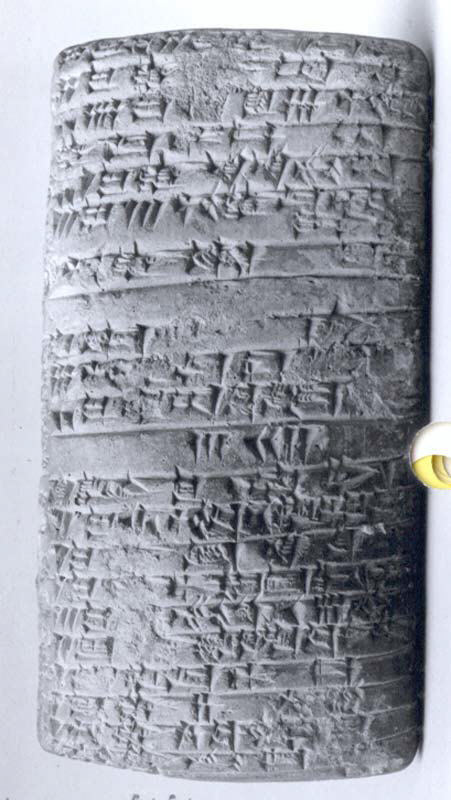
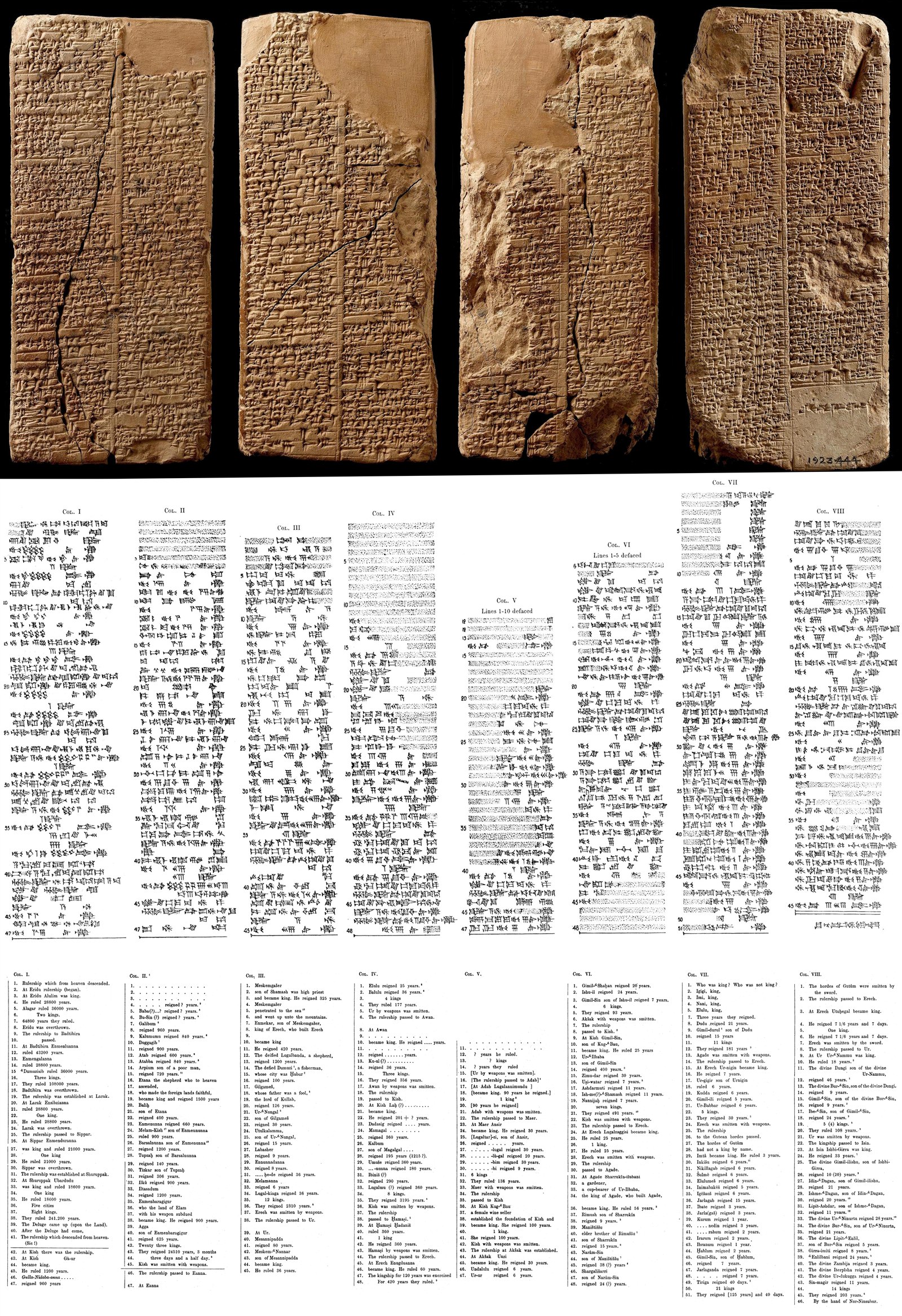
Location: Ashmolean Museum, University of Oxford Date: Approximately 1827 BC, during the reign of Sin-magir of Isin Format: Four-sided clay prism, inscribed on all four faces Completeness: The most complete surviving copy
The Weld-Blundell Prism is the document most people mean when they refer to "the Sumerian King List." It was excavated at Larsa in southern Iraq and acquired by Herbert Weld-Blundell, who donated it to the Ashmolean Museum.
The prism is inscribed in Sumerian cuneiform on all four sides, with the text running continuously from one face to the next. It includes the full pre-flood section — eight rulers across five cities, with reign lengths totaling 241,200 years — the flood notation, and the post-flood dynasties continuing through the dynasty of Isin, which was the ruling dynasty at the time the prism was inscribed.
The prism format is itself significant. Unlike a flat tablet, which can be read only on two sides, a prism presents four continuous writing surfaces. This format was used for texts that were meant to be comprehensive — complete records that the scribe intended to present as a unified whole. The choice to inscribe the King List on a prism rather than a series of flat tablets suggests that the scribe regarded it as a single, continuous document — not a collection of separate lists stitched together.
The Weld-Blundell Prism is not the oldest surviving copy of the King List. It is not the original. It is the best-preserved copy in the transmission chain — the version that provides the most complete text against which other fragments can be compared and evaluated.
The Kish Tablet
Location: Various fragments Date: Among the oldest surviving copies Provenance: Found at Kish
The Kish Tablet covers portions of the early post-flood dynasties. It is shorter and less complete than the Weld-Blundell Prism, but its significance lies in its provenance: it was found at Kish, a different city from the Prism's origin at Larsa. The two documents represent independent branches of the copying tradition. What they share, they share not because one scribe copied from the other, but because both descend from a common source.
Kish holds a particular importance in the King List tradition because the post-flood section of many versions begins with Kish as the first city to receive kingship after the flood. The fact that a copy of the list was maintained at Kish itself suggests that the city's scribal tradition preserved the document as part of its own institutional identity.
The Nippur Fragments
Location: University of Pennsylvania Museum and other collections Date: Various periods Provenance: Found at Nippur
Nippur was the intellectual and religious center of Sumer — the city of the god Enlil and the site of the most important scribal schools in the region. Thousands of tablets have been excavated from Nippur's scribal quarter, including numerous fragments of the King List.
Some of these fragments appear to be student exercises. The handwriting is less confident, the sign forms less precise, and in some cases the same text appears on both sides of the tablet — the student's attempt on one face and a corrected version or the teacher's model on the other. These practice tablets are important evidence that the King List was part of the standard scribal curriculum at Nippur.
A text that is taught in schools is a text that is institutionally maintained. Every generation of scribes learned to copy it. Every generation produced new copies. The distribution was not dependent on any single institution's decision to preserve it — it was embedded in the educational system itself.
The UCBC 9-1819
Location: University of California, Berkeley Format: Prism fragment
A partial prism covering portions of the early dynasties. Like other fragments, its primary value is in providing alternative readings where other copies are damaged, illegible, or ambiguous. Textual reconstruction of the King List depends on comparing multiple copies, and each new fragment that surfaces — even a small one — can resolve questions that the existing copies leave open.
The Ur III Fragments
Location: Various Date: Approximately 2100–2000 BC
These fragments are among the earliest datable copies of the King List and are associated with the Third Dynasty of Ur — the period when most scholars believe the King List was first compiled into a single continuous document from older source material. The Ur III period was an era of administrative centralization, when the kings of Ur sought to unify southern Mesopotamia under a single bureaucratic framework. The King List, with its narrative of kingship passing from city to city in an unbroken chain, served the political purpose of showing that the current dynasty was the legitimate heir to all of Sumer's history.
But the political purpose explains the post-flood section — the parade of dynasties ending with the current ruler. It does not explain the pre-flood section. No Ur III king gained legitimacy from Alulim of Eridu serving for 28,800 years. The pre-flood section was included not because it served the compiler's political needs, but because it was part of the source material the compiler was working from, and the compiler chose to preserve it rather than discard it.
The Schøyen Collection Tablets
Location: Private collection, Oslo, Norway Format: Several fragments
The Schøyen Collection includes fragments that preserve portions of the pre-flood section. Their significance is distributional: they demonstrate that the pre-flood record was not confined to a single city, a single archive, or a single branch of the scribal tradition. Multiple independent lines of transmission preserved the same pre-flood data — the same names, the same cities, the same numbers.
The Dynastic Chronicle (ABC 18)
Location: British Museum Period: Later Babylonian
A related but distinct document that draws on the same tradition as the Sumerian King List but reorganizes and extends it into the Babylonian period. Its existence is remarkable for a simple reason: the King List tradition survived the fall of Sumer itself.
Sumer as a political entity ceased to exist after the fall of the Third Dynasty of Ur around 2004 BC. The Sumerian language gradually fell out of daily use, replaced by Akkadian and later Babylonian. But the King List was transmitted into the new civilization — translated, adapted, and continued. The copying chain spans not just centuries but the death and replacement of the civilization that created it.
Whatever the King List recorded, the Babylonian scribes who inherited it considered it important enough to preserve across a civilizational transition. They did not discard it as irrelevant mythology from a dead culture. They kept it.
The Compilation Question
When was the King List created?
The conventional answer is the Third Dynasty of Ur, around 2100 BC. The earliest datable copies come from this period, and the political context — Ur's desire to legitimize its rule over a unified southern Mesopotamia — provides a clear motive for the document's creation.
But this answer conflates compilation with creation. What the Ur III scribes produced may not have been a new composition but an anthology — a gathering of older records from temple archives across multiple cities into a single continuous document. The pre-flood section from one archive. The early post-flood dynasties from another. The recent dynasties from the compiler's own institutional memory.
If the King List is an anthology, then the source material is older than the anthology. The question becomes: how much older?
The pre-flood section describes cities that archaeology has confirmed as among the oldest settlements in southern Mesopotamia. Eridu's earliest temple levels date to approximately 5400 BC. The pre-flood section of the King List describes governance at Eridu. If the section is based on records that originated at Eridu, those records could date to the earliest literate period at the site — or could be based on even older oral or proto-literate records that were later transcribed into cuneiform.
The city-by-city records that the Ur III compiler drew upon — the records from Eridu, Bad-tibira, Larak, Sippar, Shuruppak — have not been found. They would exist, if they exist at all, in the deepest archaeological layers of those sites. Under millennia of subsequent construction. Under the flood deposits that sealed the earliest occupation layers.
The original source material for the pre-flood King List is not missing because it was discarded or imagined. It is missing because it is buried — in the same layers that archaeology has not yet fully reached at most of the sites named in the document.
What the Copies Tell Us
The pattern of variation across copies tells us something about how the scribes treated different parts of the document.
The post-flood sections show the most variation. Different versions emphasize different cities. Some include dynasties that others omit. Numbers are adjusted. The order of dynasties is sometimes rearranged. This is what you would expect from a document that served local political purposes — each city's scribes adjusted the post-flood section to make their own dynasty look more prominent, more legitimate, more central to the story.
The pre-flood section, where it appears, is more consistent. The rulers are the same. The cities are the same. The basic sequence is the same. The reign lengths, with minor differences, are the same. This consistency is notable precisely because the rest of the document shows that scribes were willing to edit freely when they had reason to.
Not every manuscript includes the pre-flood section. The oldest surviving version begins after the flood, at Kish. The antediluvian material appears in later compilations. This means the pre-flood section was not a fixed, immovable part of the tradition from the very beginning — it was incorporated into some versions and not others, through editorial decisions we can observe but not fully explain.
But when scribes did include the pre-flood section, they did not treat it as raw material for invention. They did not add dramatic narratives. They did not embellish the rulers with heroic deeds. They did not adjust the numbers to make them more plausible or more impressive. The data — names, cities, durations — was transmitted with a consistency that suggests the scribes regarded it as something to be preserved rather than something to be improved.
The part of the document that had political utility was treated as a living text — edited, adjusted, tailored. The part that recorded the pre-flood era, where it was included, was treated with more restraint.
The scribes who maintained the King List were not passive photocopiers. They made choices. They adapted. They edited. But when it came to the pre-flood record, they chose to preserve rather than to create. That choice — made independently by scribes at different cities across different centuries — is itself a form of evidence about what the scribes believed the pre-flood section to be.
Sources & further reading
Sources: Thorkild Jacobsen, The Sumerian King List (1939); Samuel Noah Kramer, The Sumerians (1963); Electronic Text Corpus of Sumerian Literature, University of Oxford.