A Word About the Word "Myth"
Scholars call them flood myths. This page does not.
The word "myth" carries a built-in verdict. It tells the reader, before a single piece of evidence has been examined, that the story is not true — that it is a cultural artifact, a narrative invention, a symbolic expression of some deeper psychological or social truth that the storytelling culture could not articulate directly. The word does the work of dismissal before the discussion begins.
This page uses the word "tradition" instead. A tradition is something that was handed down. It makes no judgment about whether the thing handed down is factual, symbolic, or something in between. It simply acknowledges that a community preserved a memory and passed it to the next generation, and the next, and the next — across centuries or millennia — because the community considered it important enough to keep.
Over two hundred cultures around the world preserve traditions of a catastrophic flood. They span every inhabited continent. They appear in civilizations that had no known contact with one another. They are told in languages that share no common ancestor. They describe events separated by thousands of miles of ocean, mountain, and desert.
The conventional explanation is that flooding is a universal human experience — rivers overflow, coastlines shift, storms surge — and every culture eventually experiences a memorable flood that becomes the basis for a local tradition. This is reasonable. Floods happen everywhere.
But the traditions do not merely say "a flood happened." They share specific structural elements that a purely local experience does not predict. And the more traditions you examine, the harder it becomes to explain the structural similarities as coincidence.
The Sumerian Tradition
The oldest known flood tradition comes from Sumer.
The Sumerian King List records it in five words: "Then the flood swept over." This is not a story. It is a notation — an administrative interruption recorded in the same tone as every other entry in the document. Before the flood: eight rulers, five cities, 241,200 years. After the flood: kingship descends from heaven again, and the post-flood dynasties begin.
A separate Sumerian text — sometimes called the Eridu Genesis, surviving in a fragmentary tablet dated to roughly 1600 BC but believed to record an older tradition — provides more detail. The god Enki warns Ziusudra, the ruler of Shuruppak, that the gods have decided to destroy humanity with a flood. Enki instructs Ziusudra to build a boat. Ziusudra obeys. The flood comes — the text describes it lasting seven days and seven nights. When the waters recede, Ziusudra offers sacrifices. The gods grant him eternal life, and he is taken to Dilmun — a paradise associated with the rising sun.
Ziusudra is a king of Shuruppak — the last city on the pre-flood King List. His father, in some traditions, is Ubara-Tutu — the last pre-flood ruler recorded on the list. The flood tradition and the King List converge at the same city, the same family, and the same moment.
The archaeological site of Shuruppak — Tell Fara in modern Iraq — has been excavated. Flood deposits have been found there, dated to approximately 2900 BC. The deposits are real. The city is real. The convergence between the textual tradition and the physical evidence is real.
The Babylonian Tradition
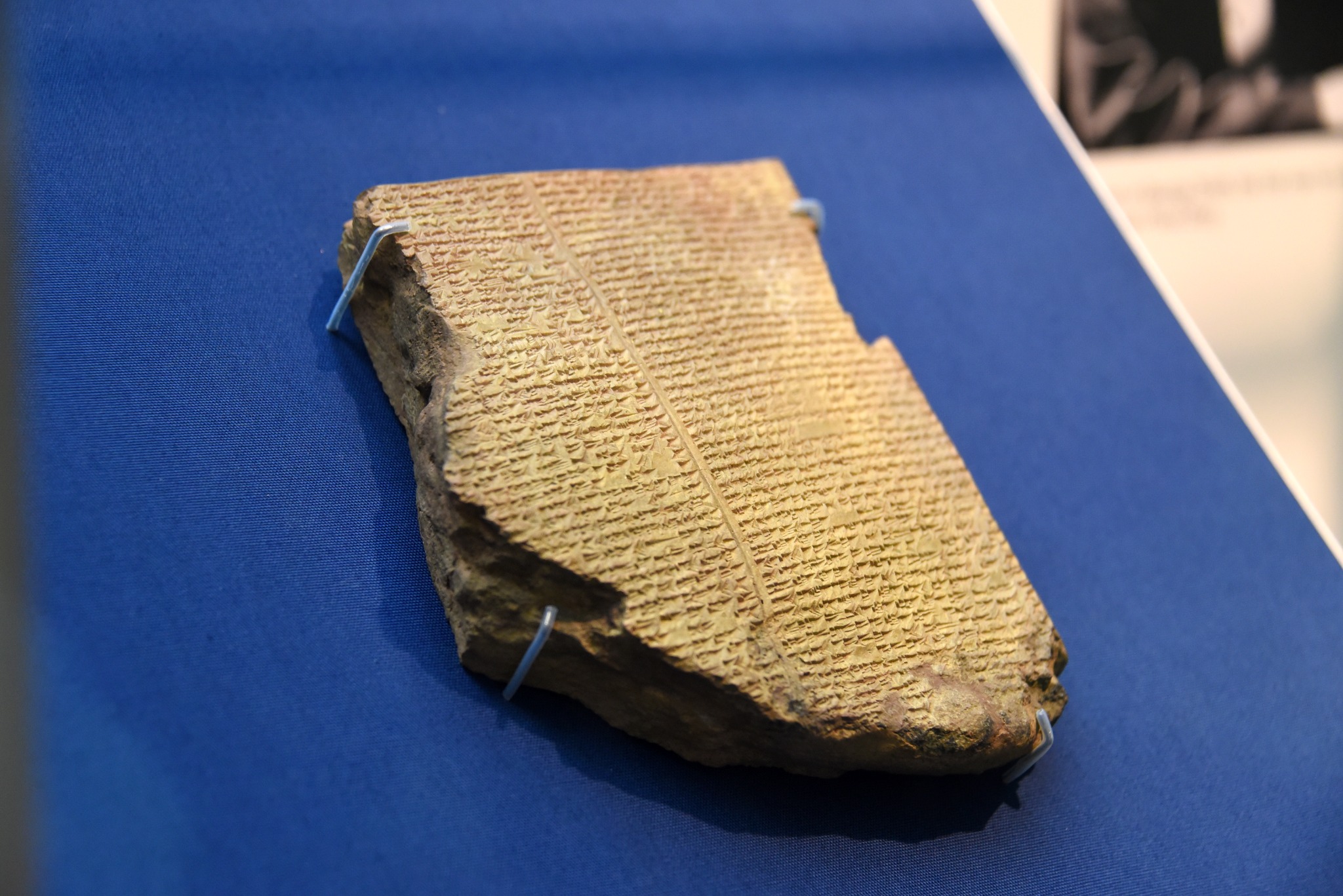
The most famous version of the Mesopotamian flood tradition appears in the Epic of Gilgamesh — specifically in Tablet XI, in which Gilgamesh travels to the end of the world to meet Utnapishtim, the one man who survived the great flood and was granted immortality by the gods.
Utnapishtim's account is detailed and vivid. The god Ea (the Akkadian equivalent of the Sumerian Enki) warns him secretly — speaking not to Utnapishtim directly but to the wall of his reed house, so that the other gods cannot accuse Ea of breaking their oath of secrecy. Ea instructs him to build a boat of specific dimensions, to seal it with bitumen, and to bring aboard "the seed of all living things."
The flood arrives. It is described as so terrifying that even the gods are frightened — they retreat to the heavens and "cower like dogs." The storm lasts six days and seven nights. When it ends, the boat comes to rest on a mountain. Utnapishtim sends out a dove, a swallow, and a raven to test whether the waters have receded. The dove and swallow return. The raven does not — it has found dry land.
The parallels to the Hebrew tradition are immediately obvious and have been recognized since the first translation of the Gilgamesh tablet in 1872, which caused a sensation in Victorian England precisely because of its resemblance to the Genesis account.
The Hebrew Tradition
The Book of Genesis records the flood in Chapters 6 through 9. God observes that human wickedness has become great and resolves to destroy the earth with a flood. Noah, a righteous man, is warned and instructed to build an ark of specific dimensions — 300 cubits long, 50 cubits wide, 30 cubits high. He is told to bring his family and pairs of every living creature aboard.
The flood comes. "All the fountains of the great deep were broken up, and the windows of heaven were opened." The rain lasts forty days and forty nights. The waters cover the earth for 150 days. The ark comes to rest on the mountains of Ararat. Noah sends out a raven and then a dove. The dove returns with an olive branch. Noah disembarks, builds an altar, and offers sacrifices. God makes a covenant never to destroy the earth by flood again, and sets the rainbow as the sign of that covenant.
The structural parallels with the Babylonian version are extensive: divine warning to one man, specific boat dimensions, animals brought aboard, birds sent out to test the waters, the boat landing on a mountain, sacrifices offered afterward. The differences are theological — Genesis attributes the flood to one God acting in moral judgment, while the Babylonian version involves multiple gods acting for various reasons, some of them petty.
The question of literary dependence — whether Genesis borrowed from the Gilgamesh tradition, or both drew from a common source, or the traditions developed independently from a shared memory — has been debated for over a century and a half. This page does not attempt to resolve that question. What matters here is the structural convergence: two traditions from the same broad region, telling recognizably the same story, with the same narrative architecture.
The Greek Tradition
The Greek flood tradition centers on Deucalion and Pyrrha. Zeus, angered by human wickedness (specifically the impiety of Lycaon, who served human flesh to the gods), resolves to destroy the human race. Prometheus warns his son Deucalion, who builds a chest or ark. The flood comes. Deucalion and Pyrrha float for nine days before landing on Mount Parnassus (or, in some versions, Mount Othrys or Mount Etna). They are the sole survivors. They repopulate the earth by throwing stones over their shoulders — the stones become people.
The structural parallels to the Near Eastern traditions: divine anger at human behavior, one righteous man warned, a vessel built, a flood that destroys humanity, a landing on a mountain, repopulation afterward. The mechanism of repopulation differs dramatically — stones instead of surviving family — but the architecture is the same.
The Greek tradition is generally dated later than the Mesopotamian and Hebrew versions in its literary form. Whether it represents independent memory, cultural borrowing from the Near East, or parallel development from a common source is debated.
The Hindu Tradition
The Matsya Purana and the Shatapatha Brahmana preserve one of the oldest Hindu flood traditions. Manu — the first man, the progenitor of humanity — is warned by a fish (who is actually the god Vishnu in avatar form) that a great flood is coming. The fish instructs Manu to build a boat and to fill it with seeds and living creatures. The flood comes. Manu ties his boat to the horn of the fish, which tows it to safety on a northern mountain. When the waters recede, Manu is the sole survivor. He performs rituals, and from those rituals a woman appears. Together they repopulate the earth.
The structural parallels: divine warning in animal form, a boat, living things preserved, a flood that destroys the world, a landing on a mountain, one man survives and repopulates. The tradition is Indian, not Mesopotamian. The theological framework is Hindu, not Semitic. The literary form is entirely independent. And yet the architecture is recognizably the same.
The Chinese Tradition
Chinese flood traditions are complex and varied, but the most prominent is the story of Gun and Yu. The great flood threatens to destroy civilization. Gun attempts to stop the flood by building dams and barriers — he fails and is executed (or, in some versions, exiled or transformed). His son Yu succeeds by dredging channels and redirecting the water rather than trying to contain it. Yu's success earns him the mandate of heaven, and he becomes the founder of the Xia dynasty — the first dynasty in Chinese tradition.
The Chinese tradition differs structurally from the Near Eastern and Indian versions in important ways. There is no single righteous survivor. There is no divinely instructed boat. The hero succeeds not by escaping the flood but by managing it through engineering. The flood is a problem to be solved, not a divine punishment to be endured.
And yet the core element persists: a catastrophic water event so significant that it serves as the dividing line between one era and the next. The Chinese tradition, like the Sumerian King List, treats the flood as the boundary between what came before and what came after.
The Pattern
These are five traditions from five independent cultural spheres. Sumerian. Babylonian/Hebrew. Greek. Indian. Chinese. They developed in different languages, different religious frameworks, different literary traditions, and — in the case of India and China — on different continents with no documented contact with the Mesopotamian world during the periods when the oldest versions of these traditions were forming.
They disagree on nearly everything specific: which god or gods were responsible, why the flood was sent, how many people survived, how the boat was built, where it landed, how humanity was restored. The details are local. The theology is local. The names, the places, the mechanisms — all local.
They agree on the structure:
A catastrophic water event destroyed the known world. It was so significant that it divides time into "before" and "after." Some form of warning was given. Some form of survival was achieved. The world afterward was fundamentally different from the world before.
What Are They Remembering?
The following grid compares structural elements across eight flood traditions. Similarity does not prove that two traditions describe the same event, and not all rows are independent — Mesopotamian and Hebrew accounts arose within historically connected Near Eastern cultural worlds.
- ✓ = explicitly present in the cited source
- — = not present / not a defining feature
- ? = damaged, incomplete, or cannot be established confidently
- Varies = multiple traditions grouped; details differ by community
| Element | Sumerian (Ziusudra) | Babylonian (Utnapishtim) | Hebrew (Noah) | Indian (Manu) | Greek (Deucalion) | Chinese (Yu) | Maya (Popol Vuh) | Australian Aboriginal |
|---|---|---|---|---|---|---|---|---|
| Catastrophic flood | ✓ | ✓ | ✓ | ✓ | ✓ | ✓ | ✓ | ✓ |
| Divine cause or involvement | ✓ | ✓ | ✓ | ✓ | ✓ | Varies | ✓ | Varies |
| Advance warning given | ✓ | ✓ | ✓ | ✓ | ✓ | — | — | Varies |
| Selected survivor(s) | ✓ | ✓ | ✓ | ✓ | ✓ | — | — | Varies |
| Boat or vessel built | ✓ | ✓ | ✓ | ✓ | ✓ | — | — | Varies |
| Family / companions | ? | ✓ | ✓ | — | ✓ | — | — | Varies |
| Animals / life preserved | ✓ | ✓ | ✓ | — | — | — | — | Varies |
| Mountain / high ground | ? | ✓ | ✓ | ✓ | ✓ | — | — | Varies |
| Birds sent to test waters | ? | ✓ | ✓ | — | — | — | — | Varies |
| Sacrifice or offering after | ✓ | ✓ | ✓ | ✓ | ✓ | — | — | Varies |
| Survivor granted special status | ✓ | ✓ | ✓ | ✓ | ✓ | ✓ | — | Varies |
| Divides time into eras | ✓ | ✓ | ✓ | ✓ | ✓ | ✓ | ✓ | ✓ |
| Humanity rebuilt afterward | ✓ | ✓ | ✓ | ✓ | ✓ | ✓ | ✓ | ✓ |
The strongest cluster of detailed correspondences appears in the ancient Near Eastern traditions: warning, selected survivor, constructed vessel, preservation of life, catastrophic water, landing after the flood, sacrifice, continuation of humanity. The Babylonian and Hebrew accounts share an especially striking additional detail: birds released from the vessel to determine whether the waters have receded.
The Indian Manu account presents another recognizable sequence: warning, coming flood, ship prepared, survivor saved, ship reaches a northern mountain, waters subside, human life begins again.
The Chinese and Maya traditions matter precisely because they are different. The Chinese Great Flood tradition centers not on a chosen family escaping in a vessel but on overwhelming flooding and Yu's effort to control the waters through engineering. The Popol Vuh's flood destroys a failed creation but does not follow the Near Eastern ark-survivor sequence. Including these rows prevents cherry-picking — the grid reveals differences as clearly as similarities.
Australian Aboriginal coastal-inundation traditions are significant for yet another reason. Researchers have documented traditions from numerous locations around Australia and argued that some plausibly preserve memories of sea-level rise more than 7,000 years ago. They should not be collapsed into one standardized "Australian flood story" — details vary by community.
Eight traditions. They are not all the same, and they should not be made to look the same. But some preserve remarkably specific combinations of details.
The question is not: "Why does everybody have exactly the same flood story?" They do not.
The better question is: Why do catastrophic-flood traditions appear in so many separated cultural records — and why do some preserve such strikingly similar sequences of warning, survival, vessels, mountains, preserved life, sacrifice, and renewal?
The conventional explanation: floods are universal experiences, and every culture eventually produces a flood tradition from local memory. This is reasonable for any one tradition. The question is whether it is sufficient to explain the structural convergence across traditions that had no contact with one another.
A local flood produces a local memory: "the river rose higher than anyone remembered." It does not, by itself, produce a narrative architecture that includes divine warning, a chosen survivor, a vessel, preserved living things, a mountain landing, and a world reset. Those specific elements are not inherent to the experience of flooding. They are narrative choices — and the same narrative choices appear in traditions separated by thousands of miles and thousands of years.
The Archaeological Record
The textual traditions do not stand alone. The physical evidence for catastrophic flooding in the ancient Near East is real.
At Ur, Leonard Woolley's excavations in the 1920s revealed roughly three meters of clean, water-deposited silt separating earlier occupation layers from later ones. Below the silt: intact settlement. Above the silt: rebuilt settlement, different in character.
At Shuruppak — Tell Fara — flood deposits have been dated to approximately 2900 BC. This is the city the King List names as the last seat of pre-flood governance, and the city associated with Ziusudra, the Sumerian flood hero.
At Kish, another site named in the King List, flood deposits have also been found — though dating to a somewhat different period than those at Shuruppak and Ur.
An important caution: these deposits do not all date to the same event. The flood layers at different Mesopotamian sites represent different floods at different times. Southern Mesopotamia, situated between two powerful rivers prone to unpredictable spring flooding, experienced catastrophic water events repeatedly across its history. Flooding was not exceptional in this landscape. It was recurrent.
The question is not whether catastrophic floods happened. The deposits confirm that they did. The question is which event — or which combination of events — survived in the traditions that every subsequent civilization in the region preserved and transmitted.
Shuruppak offers the tightest connection between the archaeological evidence and the textual record. It is both the last city on the pre-flood King List and the home of the flood hero. Its flood deposits date to roughly the period that the King List's chronological framework would suggest. The convergence is not proof. But it is a convergence that the archaeological record does not contradict.
Beyond Mesopotamia
The Near Eastern flood deposits are local. They document events in one river system in one region of the world. They do not, by themselves, explain why cultures in India, China, Greece, and the Americas preserve structurally similar traditions.
But the geological record of the past fifteen thousand years includes events that were not local.
The end of the last Ice Age produced a sustained rise in global sea levels — roughly 120 meters total, as ice sheets that had locked up enormous volumes of water gradually melted. This was not a single flood. It was a process spanning thousands of years. But within that process, there were episodes of rapid rise — periods when sea levels jumped meters within centuries, fast enough to reshape coastlines, drown settlements, and displace populations.
Meltwater Pulse 1A, roughly 14,600 years ago, may have raised global sea levels by as much as 20 meters in less than 500 years. Coastal communities around the world would have experienced this as a generational catastrophe — the sea advancing inland, year by year, decade by decade, swallowing the landscape their grandparents had known.
The Black Sea deluge hypothesis proposes that the Mediterranean broke through the Bosporus around 5600 BC and catastrophically flooded the Black Sea basin, which had previously been a smaller freshwater lake. If this event occurred as proposed, it would have displaced large populations and could have contributed to flood traditions across the Near East and southeastern Europe.
The Younger Dryas, roughly 12,900 to 11,700 years ago, saw a sudden return to ice age conditions followed by an equally sudden warming. The climate instability of this period — with its effects on glaciers, sea levels, and rainfall patterns — could have produced regional flooding events across multiple continents.
None of these events is "the flood." But all of them are real. And all of them occurred within the memory span of human civilization — a species that was already telling stories, already preserving traditions, already passing knowledge from one generation to the next.
The question is not whether humans experienced catastrophic flooding. They did — repeatedly, globally, across thousands of years. The question is why so many independent traditions preserve the same structural memory: a world destroyed by water, a dividing line between before and after, a survivor who carried something forward into the new world.
The Five Words
The Sumerian King List does not tell a flood story. It records a flood fact.
"Then the flood swept over."
No narrative. No theology. No moral lesson. No divine anger. No righteous survivor. No boat, no mountain, no rainbow. Just five words, inserted into an administrative record between one era of governance and the next.
Every other tradition wrapped the flood in story — in gods, in heroes, in moral frameworks that made the catastrophe meaningful to the culture preserving the memory. The Babylonians gave it drama. The Hebrews gave it justice. The Greeks gave it divine wrath. The Indians gave it a divine fish. The Chinese gave it an engineering solution.
The King List gave it five words.
"Then the flood swept over" describes something the archaeology proves was entirely capable of happening. Multiple catastrophic floods struck southern Mesopotamia across its history. The deposits are in the ground. The disruption to settlement patterns is documented. The region's geography — low-lying river delta between two powerful, unpredictable rivers — makes catastrophic flooding not a question of if but of when.
Over two hundred cultures remember a flood. The archaeological and geological records confirm that catastrophic flooding was a recurring feature of the Holocene. And the oldest political document in human history records the event in five words, without emotion, without narrative, as an administrative fact — and then notes that kingship descended from heaven again.
The traditions remember the flood. The archaeology confirms the flooding. The King List records the interruption.
The question is what was interrupted — and by whom it was restarted.
Sources & further reading
Sources: Electronic Text Corpus of Sumerian Literature (ETCSL), The Flood Story c.1.7.4 and The Sumerian King List t.2.1.1; British Museum, Gilgamesh Flood Tablet K.3375; Metropolitan Museum of Art, Atra-hasis tablet 86.11.378a (Public Domain / Open Access); W.G. Lambert and A.R. Millard, Atra-Hasis: The Babylonian Story of the Flood (1969); Andrew George, The Epic of Gilgamesh (Penguin Classics, 2003); Genesis 6–9; Śatapatha Brāhmaṇa 1.8.1; Apollodorus, Library 1.7.2; Leonard Woolley, Ur of the Chaldees (1929); William Ryan and Walter Pitman, Noah's Flood (1998); Patrick D. Nunn and Nicholas J. Reid, "Aboriginal Memories of Inundation of the Australian Coast Dating from More than 7000 Years Ago," Australian Geographer 47(1), 2016.