The Entry
The Sumerian King List records Etana in the First Dynasty of Kish — the dynasty that received kingship after the flood.
The entry is unlike any other in the document:
"Etana, the shepherd, who ascended to heaven, who consolidated all the foreign countries — he became king; he ruled for 1,500 years."
In a document that usually records little beyond names, cities, and reign lengths, Etana receives an unusually vivid biographical note. He ascended to heaven. He consolidated all the foreign countries. The scribe who maintained the King List chose to annotate this one entry with two remarkable claims.
The first is a title: shepherd. This is a standard epithet in Mesopotamian royal language — kings were described as shepherds of their people. It tells us that Etana was understood as a ruler, not a deity.
The second is extraordinary: he ascended to heaven. The same heaven — an — from which kingship descended at the beginning of the document. The same word. The same direction, reversed.
Kingship came down. Etana went up.
Where Etana Sits in the List
Etana's position in the King List matters.
He appears in the First Dynasty of Kish — the first post-flood dynasty, the first rulers to receive kingship after "the flood swept over" and kingship descended from heaven a second time. He is the thirteenth ruler listed in that dynasty, though the exact numbering varies between versions of the King List.
This places Etana in the early post-flood period — after the catastrophe, after the restart, but still within what appears to be an era of transition. The reign lengths in the First Dynasty of Kish are enormous by modern standards but dramatically reduced from the pre-flood numbers. Where the pre-flood rulers served for tens of thousands of years, the early post-flood rulers are measured in hundreds or low thousands. Etana's 1,500 years is long by any human standard, but it is a fraction of Alulim's 28,800 or En-men-lu-ana's 43,200.
The First Dynasty of Kish is also the dynasty that includes Enmebaragesi — one of the earliest rulers on the King List whose historical existence has been independently confirmed by archaeological inscriptions. This means the dynasty spans a range from figures with superhuman reign lengths to figures who are historically attested. It is a transitional dynasty, and Etana sits within it.
The Legend of Etana
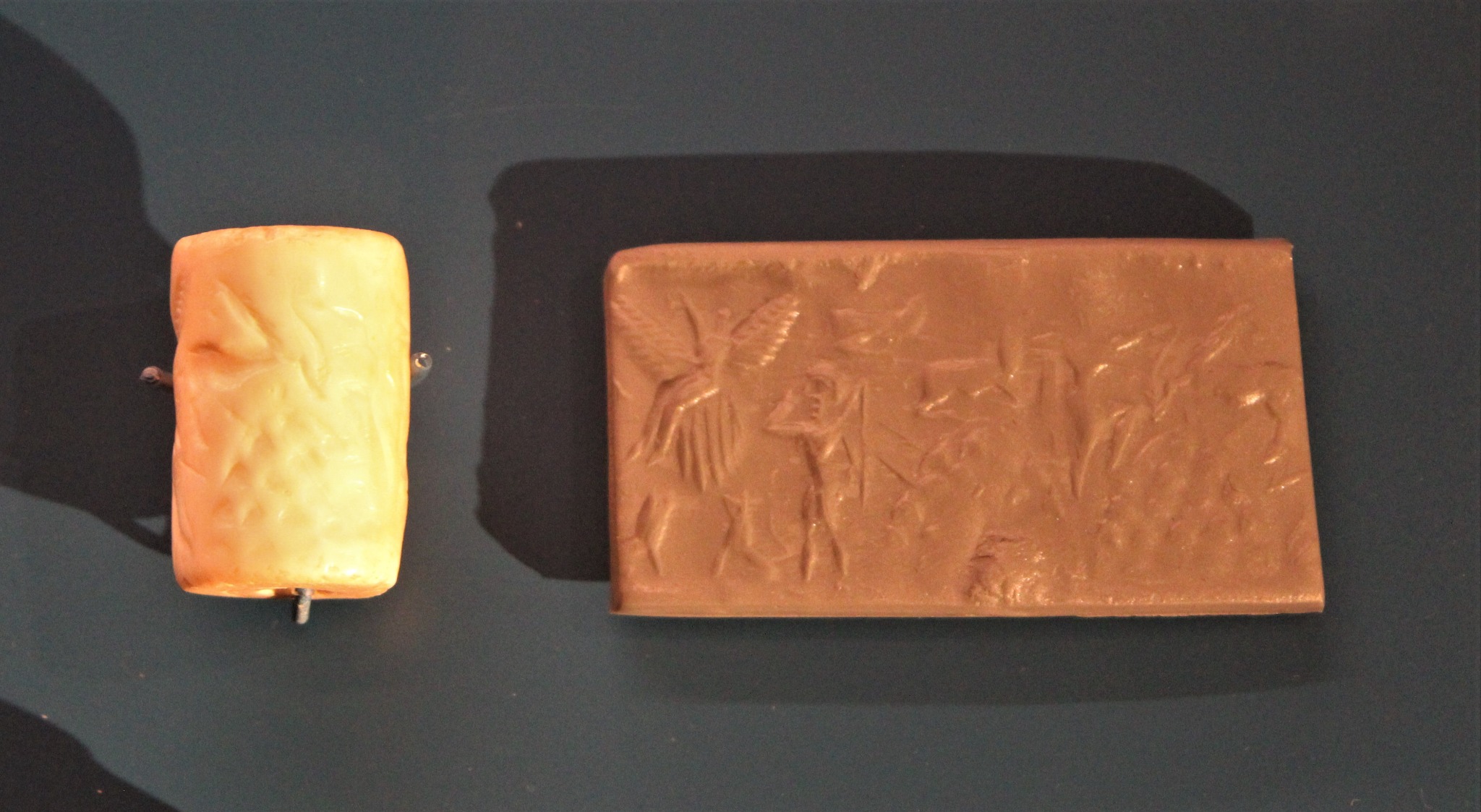
The King List is not the only text that describes Etana. A separate Mesopotamian literary composition — known as the Legend of Etana or the Epic of Etana — survives in multiple fragmentary copies from the Old Babylonian period through the Neo-Assyrian period. The text tells a story that expands considerably on the King List's terse annotation.
In the Legend, Etana is a king of Kish who desperately needs an heir. His wife cannot conceive. The remedy, he is told, is the "plant of birth" — a plant that grows in heaven. To reach it, Etana must ascend to the sky.
The mechanism of his ascent is an eagle. The story involves a complex subplot: the eagle and a serpent have sworn an oath of friendship, which the eagle violates by eating the serpent's young. The serpent, with the help of the sun god Shamash, traps the eagle in a pit. Etana rescues the eagle, and in return the eagle carries him upward on its back, toward heaven, to find the plant of birth.
The ascent is described vividly. As Etana and the eagle rise, the earth shrinks beneath them:
The land became a mere garden plot. The wide sea became a trough. The land became a furrow. The wide sea became a water bucket.
Higher and higher they climb. The description is one of the earliest known depictions of the earth seen from above — a perspective that no human being in the ancient world could have experienced naturally.
The surviving copies of the text are fragmentary, and the ending is damaged in all known versions. It is not entirely clear whether Etana reaches heaven, obtains the plant of birth, and returns — or whether the ascent fails. Some scholars reconstruct a successful conclusion based on indirect evidence: the King List records that Etana was succeeded by his son Balih, which suggests that an heir was eventually produced.
What the Texts Agree On
The King List and the Legend are different types of document — one a king-list tradition, the other a literary narrative. They were composed and maintained for different purposes. But they agree on specific points:
Etana was a king of Kish. Both texts place him at the same city.
Etana ascended to heaven. The King List states this as a biographical fact. The Legend narrates the ascent in detail.
Etana was human. He is a shepherd, a king, a man who needs an heir. He is not a god. He is not one of the pre-flood rulers with their tens-of-thousands-year reigns. He is a post-flood figure — a human ruler in a human city — who went somewhere that humans do not go.
The ascent is narrated as physical. The Legend describes the earth receding as Etana rises. This is not a mystical vision, a dream, or a spiritual journey to a metaphorical heaven. The text describes physical altitude — the land shrinking, the sea becoming a trough. Whatever the literary conventions of the era, the author is describing someone going up and looking down.
The Conventional Reading
Scholars treat the Legend of Etana as mythology — a literary narrative that explores themes of kingship, divine aid, and the boundary between the human and divine realms. In this reading, the ascent to heaven is a narrative device that represents Etana's exceptional status as a king favored by the gods. It is not a description of a literal event.
This reading is supported by the text's literary qualities. The eagle and serpent subplot is clearly a fable. The dialogue between Etana and the eagle is stylized and dramatic. The structure follows recognizable patterns of Mesopotamian literary composition.
The conventional interpretation is reasonable. Mythology uses ascent to heaven as a recurring motif — Elijah in the Hebrew Bible is taken up in a chariot of fire, Heracles ascends to Olympus, and numerous other traditions describe exceptional individuals being taken to the realm of the gods.
What the conventional reading does not fully address is why the King List — a document that occasionally preserves brief accomplishments but usually records little beyond names, cities, and reign lengths — includes the ascent to heaven as a biographical detail.
The King List notes that Enmebaragesi "made the land of Elam submit." Brief deed annotations are not without precedent. But Etana's annotation is exceptional: it says that he ascended to heaven. That is not a military campaign or a political achievement. It is a claim about crossing a boundary that humans do not cross.
The Enoch Parallel
Etana is not the only ancient figure presented as human and described as crossing from earth into heaven.
The Hebrew Bible records that Enoch — the seventh patriarch in the Genesis genealogy — "walked with God, and he was not, for God took him" (Genesis 5:24). The implication, developed extensively in later Jewish tradition and in the Book of Enoch, is that Enoch was taken to heaven without dying. He did not die and go to the afterlife. He was taken — physically removed from the earth by God.
The King List’s pre-flood ruler En-men-dur-ana of Sippar is the seventh ruler in the antediluvian sequence, and some scholars have compared him with Enoch. Both are seventh in a pre-flood sequence, and both later became associated with extraordinary heavenly knowledge. In the later Akkadian tradition, where he is called Enmeduranki, the gods Shamash and Adad bring him into their assembly and give him the arts of divination. The comparison is debated, and the sources do not prove a direct borrowing. More on him is on the Sippar page.
Etana adds a post-flood parallel to the same pattern. A human ruler. A physical ascent. An experience of the heavens described in terms that imply actually being there — seeing the earth shrink, watching the landscape recede.
Three figures, across two cultural traditions, described as going to heaven and — in at least some accounts — returning with knowledge or status they did not have before. The traditions are not identical. The mechanisms differ. The theological frameworks are different. But the structural pattern recurs: certain individuals, at certain moments in the ancient record, are described as crossing the boundary between earth and sky.
The View from Above
One detail in the Legend of Etana deserves separate attention.
The description of the earth shrinking as Etana rises — the land becoming a garden plot, then a furrow; the sea becoming a trough, then a bucket — is a description of altitude. It describes what the earth looks like when you are above it and getting higher.
No human being in ancient southern Mesopotamia could have experienced this perspective at anything approaching the altitude implied by the story. There were no mountains in the alluvial plain from which to observe the landscape at such scale.
The author was either imaginatively extrapolating far beyond ordinary experience — or preserving a description attributed to someone who had seen such a view.
The Question
Etana sits at a unique intersection in the Mesopotamian record.
He is post-flood — a human ruler in a human city, with a human problem (he needs an heir). He is not one of the pre-flood rulers with their incomprehensible reign lengths and their absence of tombs.
He is described, in the most austere document in Mesopotamian literature, as having ascended to heaven — the same heaven from which kingship originally descended.
He appears in a literary text that describes his ascent in physical terms — terms that include a detailed description of the earth seen from above, a perspective no human of the era could have experienced naturally.
And he consolidates "all the foreign countries" — a phrase suggesting authority or accomplishment on a scale unusual for a city-king of early Kish.
The conventional reading explains all of this as mythology, literary imagination, and royal ideology. That reading accounts for the evidence.
But it does not account for why the King List — a document that only rarely preserves biographical details — chose to record that this one went up. Or why the literary tradition described the view from above with a specificity that exceeds what imagination alone would require. Or why the pattern of ascent appears in multiple ancient traditions, for figures who are described as human, not divine.
Kingship descended from heaven. Etana ascended to it.
In a document that usually records little beyond names, cities, and reign lengths, the scribe considered Etana's ascent worth writing down.
Why?
Sources & further reading
Sources: Electronic Text Corpus of Sumerian Literature (ETCSL), The Sumerian King List, t.2.1.1; J.V. Kinnier Wilson, The Legend of Etana (1985); Stephanie Dalley, Myths from Mesopotamia (Oxford World's Classics, 2000); Thorkild Jacobsen, The Sumerian King List (1939).